
No Fail Homemade Mayonnaise Recipe
If you’ve ever wondered if there was a better way to do mayo, this homemade mayonnaise recipe is for you.
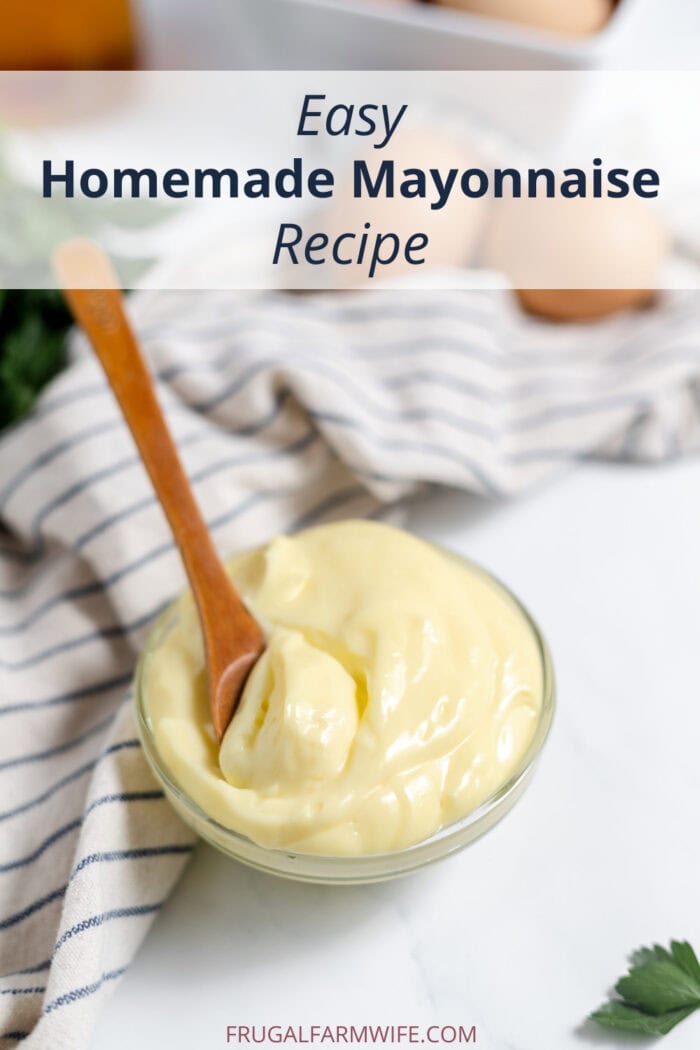
I promise you, it’s easy. This is hands-down the easiest way to control ingredients in your food, and kick seed oils to the curb. And yes, I know that being anti-seed oil is controversial, and maybe you have no problem using them – that’s totally fine! To be fair, I started making my own mayonnaise for the sole reason that I had too many eggs, and this was just one more way to use them.
Ingredients for homemade mayonnaise
These ingredients are simple, and likely already on your pantry shelves. Some recipes use slightly different ingredients than others, which we’ll address below, but the basics are all the same.
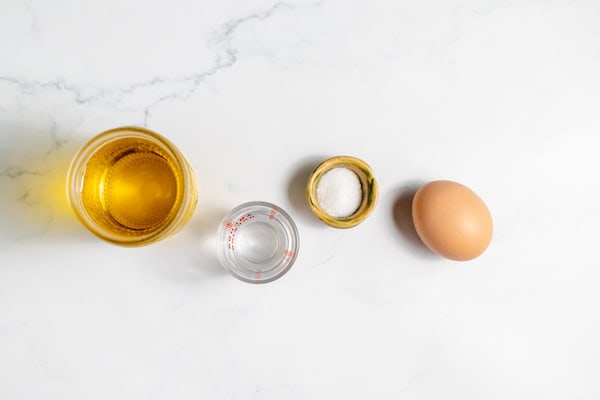
- Egg. Some recipes use egg yolks only, as this is the key to emulsifying your oil. However, using whole eggs produce a lighter, stiffer, mayonnaise.
- Salt. This acts as both a flavor enhancer, and a preservative in your mayonnaise, helping ward off harmful bacteria for longer.
- Lemon juice (or vinegar). This is also a flavor enhancer, and lowers the pH of your mayo, to create a less hospital environment for bacteria.
- Oil. I almost always use light tasting olive oil to make mayonnaise. This is not technically the most nutritious oil, but I find it’s a good compromise because it has some of the same benefits of virgin olive oil, but doesn’t harden in the refrigerator. As mentioned above, seed oils such as vegetable (soy), corn, or canola oil are most popularly used in making mayonnaise, and certainly the easiest and cheapest, but they’re not for me.
You can get creative with the oils you use, but you have to be aware of the changes you make. For instance, you can use melted, cooled coconut oil (virgin coconut oil will taste like coconut, but expeller pressed is usually neutral), but when refrigerated, it will harden up, and then separate as it warms again. The same is true of mayo made with extra-virgin olive oil, although it doesn’t completely harden like coconut, elements of it do, and so the result is the same.
You can also use safflower, or avocado oil.
Many people add a half teaspoon of dijon mustard, or a generous pinch of mustard powder to their mayonnaise for extra flavor. I don’t add this because it’s not compatible with my family’s tastes.
Other things you may want to add is a clove of crushed garlic, or 1/4 teaspoon garlic powder to make garlic mayo, or a pinch of cayenne powder to make spicy mayo.
Are raw eggs a concern? Raw eggs do carry a low risk of salmonella, and the USDA does not recommend consuming them. If raw eggs are a concern for you, you can easily pasteurize your eggs before using them.
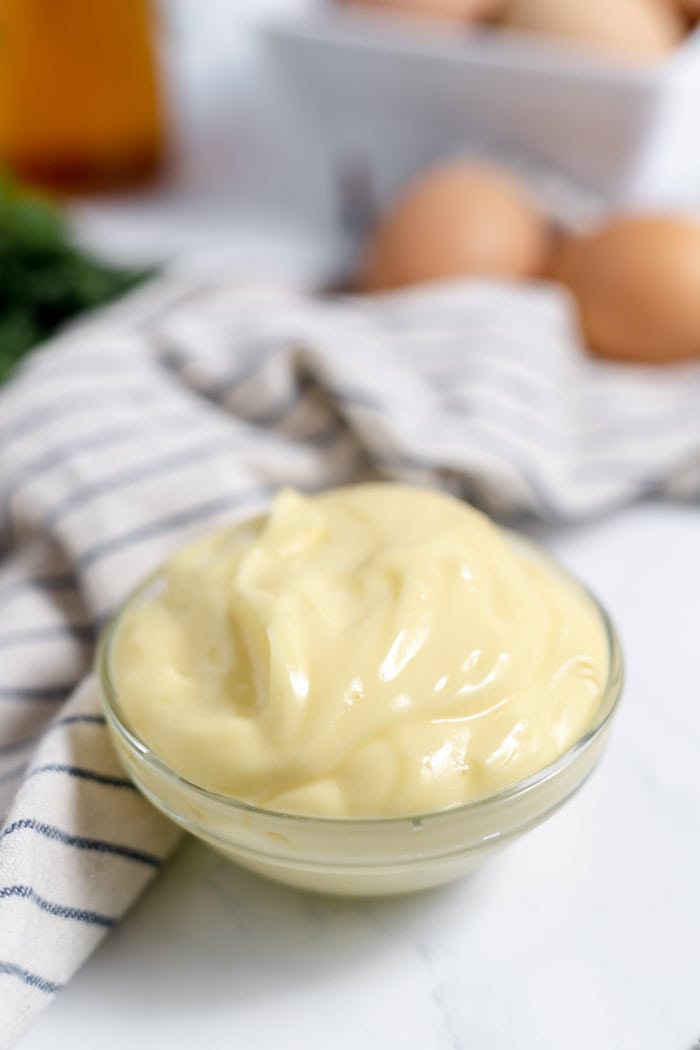
How to make homemade mayonnaise
The key to mayonnaise is emulsification. This simply means that we have two ingredients that don’t mix (immiscible liquids), and forcing them to combine through force.
The easiest way to do this is to gradually add your oil to the emulsifier (egg) while blending. This is the most fool proof way, but not the only way. A lot of us find that adding all ingredients to a jar, and then mixing with a really fast immersion blender also works well.
I have used the immersion blender method often, and it usually works, but it is also the method that is mostly likely to fail, so if really depends on the risk you’re willing to take. Also keep in mind that if your mayo doesn’t quite set up, you can still use it, so it’s not necessarily a waste.
Still, because it can fail more easily, I tend to add the oil gradually even when I do use the stick blender.
So, these are instructions for no-fail homemade mayo
- Crack egg into your blender or food processor.
- Add salt and lemon juice (or vinegar), put the lid on, and give it a whirl.
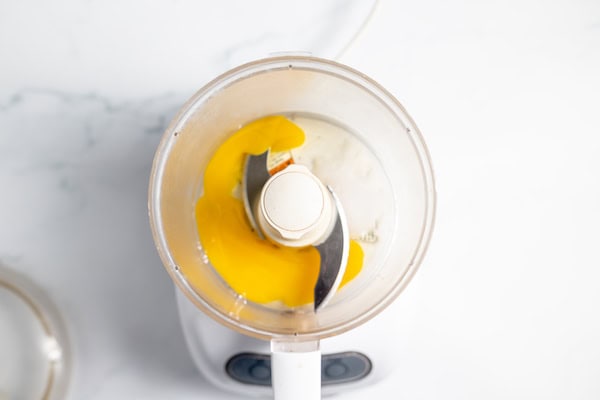
- Turn food processor on, and open the food tube portion of the lid.
- While blending, begin to pour oil into the egg mixture in a thin, steady stream.
- When oil is all added, continue blending for up to a minute to finish the emulsification.
- Turn processor off, and open lid.
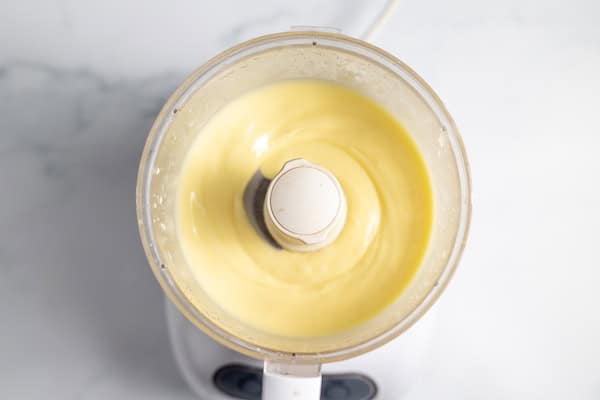
- Use a rubber spatula to scrape mayonnaise into a jar, or tight-lidded container for storage.
- Store in the refrigerator, and use within one week.
Unlike store-bought mayo, your homemade version will begin to mold if left out at room temperature for an extended period of time, and will eventually start to mold in the refrigerator as well.
How to fix mayonnaise that breaks down
If you use a quality oil, and good eggs, you will hopefully never encounter a problem with your mayonnaise. However, if it does break down (if for instance you use coconut oil, it hardens in the fridge, and causes separation as it thaws), there are two things you can do:
- Add a tablespoon of boiling water, and blend. Your mayonnaise may be slightly thinner with this method, but it should help bring it all back together in one smooth emulsification.
- Add an egg yolk and blend. This one works, because it’s almost like making a fresh batch.
The key here with all of these options is blending – that’s the key to mayo.
Delicious recipes using your homemade mayonnaise:
Your homemade mayo can be used in any way you use mayo from the grocery store, such as on sandwiches, in tuna salad, chicken salad, potato salad, or egg salad.
Here are some other recipes:
- Simple apple salad
- Creamy cucumber salad
- Broccoli pasta salad
- Bacon Broccoli salad
- Homemade Ranch Dressing
Easy Blender Mayonnaise
Making your own mayonnaise is super easy, and delicious!
Ingredients
- 1 egg
- 3/4 teaspoon salt
- 2 T. lemon juice or vinegar (I use white wine vinegar)
- 1 cup neutral oil
Instructions
- Combine first three ingredients in the bowl of a food processor or blender, place lid on, and blend together
- Open the food chute of your processor, and slowly pour in oil while blending. Your mixture will become opaque and thicken as oil is blended in.
- Continue blending for 30-60 seconds after the oil is completely incorporated to thicken the emulsion.
- Use a rubber spatula to scrape mayonnaise out of the blender, and into a jar or container with an air-tight lid.
- Store your mayonnaise in the refrigerator for up to a week.
- Enjoy!


Do the raw eggs in this not cause any concerns? I am wanting to try it, but can’t get past the raw eggs!
There are a lot of reasons I don’t worry about salmonella, starting with buying eggs from local farmers who pasture their flocks.
That said, it’s also very easy to pasteurize eggs to virtually eliminate harmful bacteria. (I learned in confectionary class that salmonella is killed at 136ºF). Anyway, here’s tutorial on how to pasteurize them yourself: http://bakingbites.com/2011/03/how-to-pasteurize-eggs-at-home/
I just tried this, after having trouble with consistency for a 100 year old German recipe. That one used only the yolk whereas this uses the whole egg. Started off very liquid but as soon as I started to add the oil very slowly, and using speed one on the stick blender, it all began to gel. So pleasantly surprised at how well it came together. A mild taste but oh so creamy. Makes a nice base for other things such as aeoli. Thank you very much for this!
Love the simplicity of this recipe. I used avocado oil, as the Greek olive oil I was using is no longer available. All the olive oils leave a harsh taste. I will be adding some spices from my 100 year old recipe from a German cookbook, which I couldn’t make with the same consistency. Thank you so much for publishing this!